Ecuador facts and history in brief
Quito, is the capital of Ecuador and
of Pichincha Province.
The city is in a narrow, fertile,
picturesque valley of Pichincha
volcano in the Andes at an
elevation of 2,850 m (9,350 ft)
above sea level.
Due to the altitude Quito
has a pleasant, moderate
climate in spite of being
just south of the equator.
Quito has little heavy industry.
Its chief manufactured products
include textiles, processed food,
beverages, leather, cement,
furniture, and gold and
silver craftware.
The city is linked to the
Pacific Ocean by roads and
a railway and is on the
Pan-American Highway.
Quito is one of the oldest
South American capital and
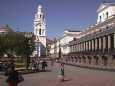
retains much of its colonial aspect.
Under Spanish colonial rule
it became a provincial capital,
responsible to the viceroy; and
in 1535 the church and monastery
of San Francisco, built on the
city's main plaza, became the
first Christian foundation in
South America.
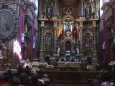
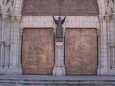
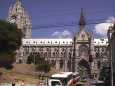
Endowed with many Spanish Baroque
style architecture from its colonial
days.
The best example is 17th-century
cathedral and the churches of
San Francisco, San Augustin,
La Compañía, and Santo Domingo.
The city is laid out mainly according
to a rectangular plan with an
expansive central plaza, many
quiet parks and flower gardens,
and numerous steep narrow streets.
The site of Quito was settled since the
5th or 6th Century, and it became
successively the fortified capital
of several native groups, including the Quito.
Later it was the northern provincial
capital of the Inca empire, linked by
a long road to Cuzco, the imperial capital.
In 1530 it was governed by Atahualpa,
who used it as a base to seize the rest
of the empire, defeating his
brother and co-ruler, Huascar.
In 1534 it was captured by the
Spanish conquistador Sebastián de
Belalcázar, a lieutenant of Francisco Pizarro.
The Spanish made it the capital of
the presidency of Quito.
In 1822 the city was liberated by
Antonio José de Sucre, the commander
of the South American troops in their
revolt against Spanish rule.
Quito was Ecuador's chief economic
centre until the early 20th century,
when it was replaced by Guayaquil.
The city has been damaged by several
earthquakes in the 19th century.
The city is the site of the Central
and also the Catholic University
of Ecuador and many other schools
of higher education.
Population around 2 million.

We felt a bit lost at our
arrival at Quito Airport as not
many Quito people speak English and the
airport is rather chaotic.
The 'Information' people were much
in a hurry, I do not know of what.
Their only advise was get
a Taxi, only US$5 to town.
Hui Chin and I, being always
on short 'shoelace' budget,
always trying to avoid
using Taxis, as being one
of the most expensive way of travel.
In the end we found our
way immediately cross the road
and catch a "Aeropuerto", "Quito Norte"
public bus.
A young lady explained to
Hui Chin where to get off
the bus and find our Hotel.
We didn't like our hotel and a couple
of other nearby ones either.
Hui Chin managed to get lost,
while checking out the
Hotel Amazonas, which
was a bit more expensive
than we were planning for,
but was very nice to stay at.
The Old Town, the old city centre,
the over glorified "Trolly", the
'Old Town' market and the very old
church of San Francisco were a very
interesting experiences.
We did enjoy our stay in Quito.
You can click on these photos for an enlargement.
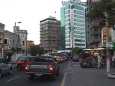 |
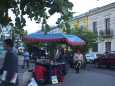 |
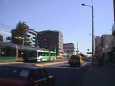 |
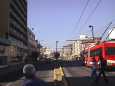 |
|
Quito |
Quito |
Quito |
Quito |
 |
 |
 |
 |
|
Quito |
Quito |
Quito |
Quito |
 |
 |
 |
 |
|
Quito |
Quito |
Quito |
Quito |
Site
Index
Back to Top
Photos Index
Thanks for coming, I hope you
have enjoyed it, will recommend
it to your friends, and will come
back later to see my site developing
and expanding.
I'm trying to make my pages
enjoyable and trouble free for everyone,
please let me know of any mistakes
or trouble with links, so I can
fix any problem as soon as possible.
These pages are best viewed with monitor
resolution set at 640x480 and kept simple
on purpose so everyone can enjoy them
across all media and platforms.
Thank you.
Webmaster

|