Guayaquil is Ecuador's largest
and fast-paced city, principal seaport,
industrial, commercial centre, situated
at the mouth of the Guayas River.
Named after the legendary Indian prince and
princess Guayas and Quil.
It is about 65 kilometres from the
Pacific Ocean on the Guayas River
only 4 meters above sea level and
is surrounded by marshes and salt flats.
Ocean-going ships reach Guayaquil's
deep-water port by way of the Gulf
of Guayaquil and the Estero Salado
ship channel, which is 58 kilometres long.
The city was founded by the Spaniard,
Francisco de Orellana in 1537, one
of the first explorer of the Amazon.
Guayaquil always have been an important
port and was looted by pirates several
times.
Today's major industries include
trading in fruit, especially bananas,
oil refining, manufacturing plastics,
textiles, pharmaceuticals, food products,
vehicles, and electrical equipment.
The city also has breweries, a cement
factory, flour mills, ironworks,
sawmills, small shipyards, and textile mills.
Guayaquil experienced very rapid
growth since the 1950s, especially
due to the growth of the banana
industry.
Due to rapid growth and 'urban shift'
the city is very crowded.
Over crowding and poverty is imminent in
the squatters settlements called "suburbios",
on the land-filled marshes, that flood
often and stretches the city's ability
to provide better housing, water,
and garbage collection.
The city's close proximity to the
equator makes the climate humid
and very hot just about all year
around.
The rainy season is from January to
April, and the dry season May to
December, may be overcast but agreeably cool.
Guayaquil not a very well known
tourist destiny, mainly used as
a jumping point to get to the Galapagos
Islands or the famous Alausi train.
The city's attractions include the
Municipal Museum (With it's famous shrunken heads),
the Archaeological Museum of
the Banco Central,
the Archaeological Museum of the Banco del Pacifico,
the Casa de Cultura (With it's collection of gold),
the Iglesias de San Francisco and
de Santo Domingo churches,
the "Las Penas" colonial district,
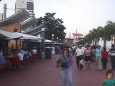
the Malecon Simon Bolivar (The Strand),
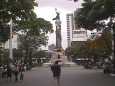
the Parque del Centenario, and
the La Bahia market near the waterfront.
A monument marks the meeting in 1822
of the liberators Simon Bolivar
and Jose de San Martin in the
Parque del Centenario.
Due to the large population (More
than 2 million) the city suffers
from air and water pollution,
chaotic, congested traffic, and
an unstable water supply.
Quito, the capital and Guayaquil
always had an fierce political rivalry.
It is said that if Quito is the
head of Ecuador, Guayaquil is its
heart.

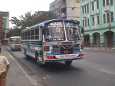
We grabbed a bus on our arrival
to get to our hotel.
The only trouble was
that we used the wrong page or town in our
guide book and in Ecuador it appears that
hotel and street names are much the same in most towns,
although the same hotel might not be on
the same street in the other town.
Our first choice of hotel was too
expensive (In Guayaquil), so we
looked for the address for another
hotel.
Now the fun started because
according to the Guaquilians,
our hotel was to the east, but the street, where the
hotel should have been was to the west.
Our hotel was on a corner of 'x' and 'y' streets.
In Guayaquil, they had both streets,
but miles apart and never cornering each other.
After about 30 minutes of conflicting
directions and advice, but still
did not knowing the cause of our
confusion, we decided to walk towards
the most commonly received direction.
We could not waste a taxi fare in such a confusion.
During our walk, we kept to our direction, although
we asked many times for directions on our way
which only added to our confusion.
But the fact that large towns have
many hotels came to our help.
After about thirty minutes walk from the
Parque del Centenario to near the end of Olmedo,
which was in utter chaos at the time, as the
road and services beneath the road being rebuilt, as
well as being in the middle of a very busy market.
We came upon about six hotels in
one block and one across the road.
We were rather tired, but we did not
like any of the six hotels, so I left
Hui Chin with our luggage and
ventured across the road to
check the hotel out.
It appeared suitable and affordable
to us, so we showered and changed
quickly to refresh and explore the
market all around us.
We found many cheap and good
eating and drinking places
not far from our hotel on
the Malecon Simon Bolivar,
to which we returned a few times.
The following day we explored, the city,
the Cathedral, the Malecon,
market and Downtown on foot to
get to know the place thoroughly.
Guayaquil came out all right on
our experiences.
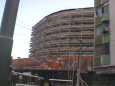
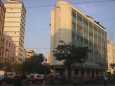
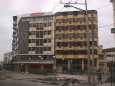
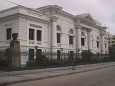
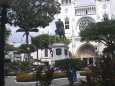
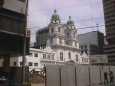
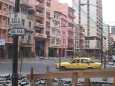
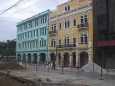
You can click on these photos for an enlargement.
 |
 |
 |
 |
|
Guayaquil |
Guayaquil |
Guayaquil |
Guayaquil |
 |
 |
 |
 |
|
Guayaquil |
Guayaquil |
Guayaquil |
Guayaquil |
 |
 |
 |
 |
|
Guayaquil |
Guayaquil |
Guayaquil |
Guayaquil |
Site
Index
Back to Top
Photos Index
Thanks for coming, I hope you
have enjoyed it, will recommend
it to your friends, and will come
back later to see my site developing
and expanding.
I'm trying to make my pages
enjoyable and trouble free for everyone,
please let me know of any mistakes
or trouble with links, so I can
fix any problem as soon as possible.
These pages are best viewed with monitor
resolution set at 640x480 and kept simple
on purpose so everyone can enjoy them
across all media and platforms.
Thank you.
Webmaster

|