Ecuador facts & history in brief
Galapagos Islands are a group of thirteen
large islands and many small ones
spread across the Equator in the
Pacific Ocean.
They are also called the Archipelago
de Colon and are situated about
1,000 km (600 miles) west of Ecuador,
to whom they belong to.
They consist mainly of volcanoes
that have developed on an east west axle
of fracture zone and which rise up
to 3,000 m (10,000 feet) from the sea floor.
They then stand a further 1,800 m
(6,000 feet) above sea-level and cover
an area of 7,844 square kilometres.
The resulting scenery is striking
large summit craters, fresh lava
flows, and impressive sea cliffs
diversify a generally rugged topography.
The islands once were known as
the Enchanted Isles, where Pirates
buried their stolen treasure, castaways
found refuge and sometimes
Mutineers were left there.
The Galapagos Islands are well known
for the diversity of some unusual,
sometime strange birds and
animals that live there.
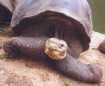
There are giant tortoises that
weigh more than 230 kilograms.
The Spanish word for the tortoises,
galapagos, gave the islands their name.
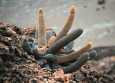
Most extraordinary of all the animals
in the Galapagos are the lizards
called iguanas.
Many of them are over 1 metre long.
Other animals include herons, sea
birds called boobies, and scarlet
crabs, which are the same as an
Atlantic species from which they
have been separated for possibly
35 million years, also birds like
penguins that cannot fly and mockingbirds
of a type unknown elsewhere.
The five largest islands are Isabela (Albemarle),
Santa Cruz (Indefatigable), San Cristobal
(Chatham), Fernandina (Narborough), and
San Salvador (James).
In 1942, Ecuador allowed United States
troops to establish a base on the
Galapagos to guard the Panama Canal.
The United States returned this base
to Ecuador in 1946, after World War II.
In 1835, Charles Darwin made a study
of the animals found on the 15 islands
and written a very controversial book
about the time about his
theories about evolution.
About 8000 people live on the islands.
The Galapagos Islands are National
and World Heritage Park today.
Every visitor to the islands have
to pay US$100 on landing, that
goes to the security and maintenance
of the islands.
We would probably have seen more
animals at our local
zoo, than we seen on our visit to
the Galapagos Islands.
I have strong suspicion, that the wild life
have been pre warned of our visit,
much the same as in the Amazon Jungle.

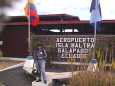
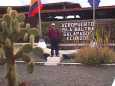
You can click on these photos for an enlargement.
 |
 |
 |
 |
|
Galapagos |
Galapagos |
Galapagos |
Galapagos |
 |
 |
 |
 |
|
Galapagos |
Galapagos |
Galapagos |
Galapagos |
Site
Index
Back to Top
Photos Index
Thanks for coming, I hope you
have enjoyed it, will recommend
it to your friends, and will come
back later to see my site developing
and expanding.
I'm trying to make my pages
enjoyable and trouble free for everyone,
please let me know of any mistakes
or trouble with links, so I can
fix any problem as soon as possible.
These pages are best viewed with monitor
resolution set at 640x480 and kept simple
on purpose so everyone can enjoy them
across all media and platforms.
Thank you.
Webmaster

|